

Best Window Furnishings for Reducing Street Noise
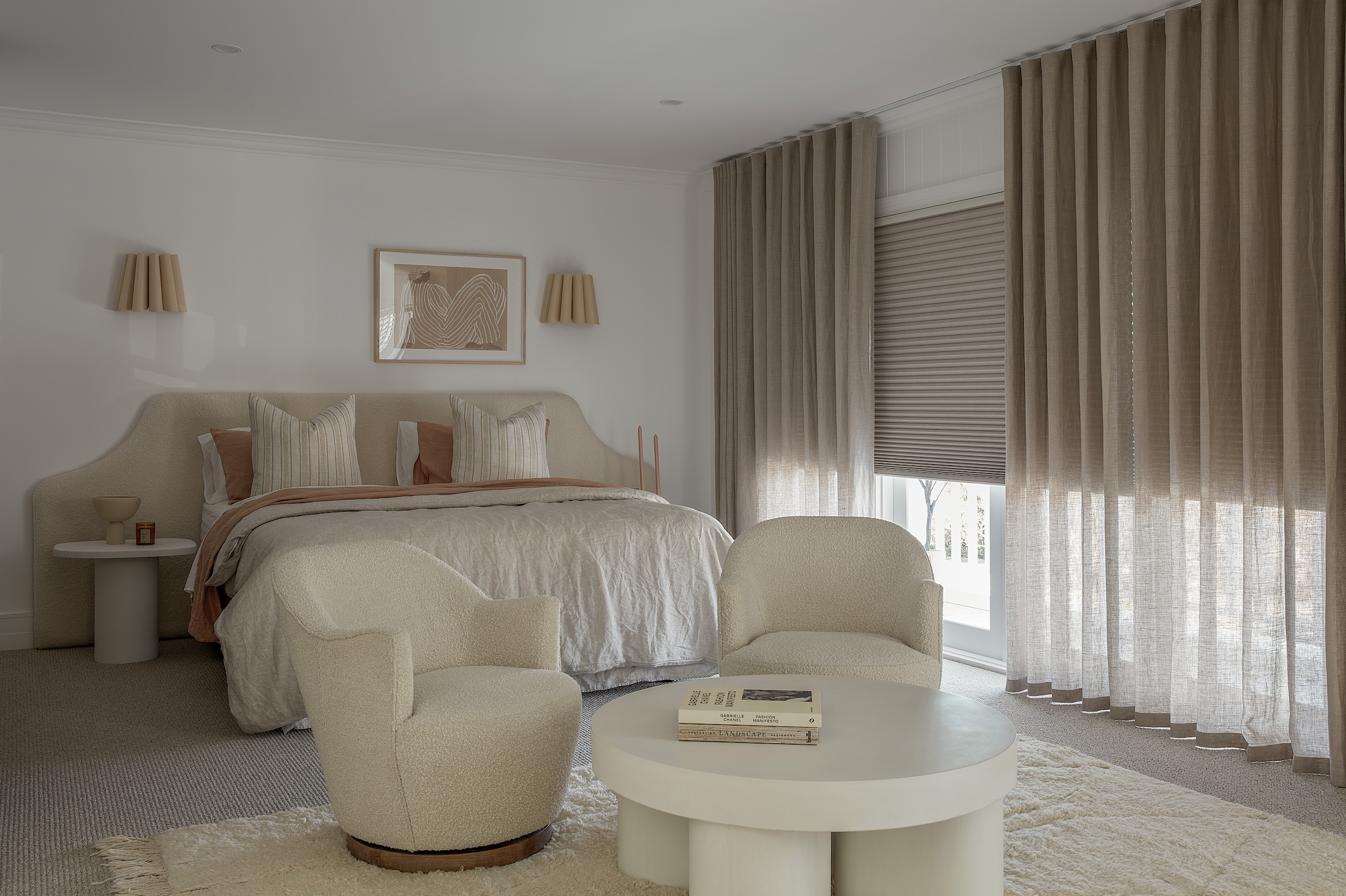
If you live on a busy road, near a train line or in a high traffic area, street noise can have a significant impact on how comfortable your home feels.
We’re often asked whether curtains or blinds can help reduce outside noise. The short answer is yes, they can help, but some window furnishings are much more effective than others. It is also important to be realistic about what a window furnishing can achieve. If a lot of noise is coming through the window itself, curtains alone aren't going to solve the problem.
At Nicholls Interiors, we have been designing and installing custom window furnishings in Melbourne homes for more than 100 years. When we're working with a home affected by traffic or street noise, we generally want to introduce as much soft, dense material around the window as practical, without compromising how the room looks or functions.
Do curtains actually reduce street noise?
Yes, curtains can help, particularly when they are full, floor-to-ceiling and made with substantial fabrics and linings. They won't soundproof a window, but all that fabric helps absorb sound rather than allowing it to bounce around a room. In our experience, this can make a room feel noticeably softer and quieter.
For the best result, we generally recommend curtains that:
Run from close to the ceiling all the way to the floor
Extend well beyond the window opening on both sides
Have generous fabric fullness
Use a substantial face fabric with a quality lining
Include an interlining where appropriate
Sit reasonably close to the window when closed
The more completely we can cover the window area, the better. A small curtain that only just covers the glass isn't going to provide the same benefit as a properly fitted, full-height curtain with plenty of fabric.
What are the best curtains for reducing noise?
For street-facing rooms, our preference is generally a full, lined curtain with plenty of fabric and an interlining.
A heavier fabric can certainly help, but weight isn't the only consideration. How the curtain is made, how much fabric is used, how well it covers the window and the number of layers between the room and the glass all matter. We will often add a bumf interlining between the face fabric and lining. This gives the curtain another soft, dense layer and has the added benefit of creating a fuller, more luxurious curtain.
Where the room allows for it, we might also combine a sheer curtain with a lined blockout curtain. This gives you multiple layers at the window, while the sheer can remain closed during the day for privacy and the heavier curtain can be closed at night.
Are blinds good for reducing street noise?
Blinds can contribute, but we wouldn't generally choose a blind alone if reducing street noise was the main priority.
Cellular blinds, such as Luxaflex Duette Shades, are one option we often use where insulation is also important. Their cellular construction creates pockets of air at the window and they are an excellent product for thermal insulation. Where noise is a concern, we would usually look at whether a blind could be combined with curtains rather than expecting the blind to do all the work.
Again, it comes back to layers.
Curtains or blinds: which are better for street noise?
If a client came to us and said reducing street noise was their main priority, we would generally recommend curtains over a blind alone. There is simply a lot more soft material in a full curtain, particularly once you add lining, interlining and generous fullness.
That doesn't mean you necessarily have to choose one or the other.
A combination we use regularly is a blind fitted at the window with full-height curtains in front. This gives you flexibility with privacy, light and insulation while also adding plenty of fabric to the room.
What about sheer curtains?
We love sheers, but we wouldn't recommend a sheer curtain on its own if reducing noise was one of the main objectives. A sheer will soften a room and is certainly better than leaving a large expanse of glass completely uncovered, but it doesn't have the weight or density of a lined curtain.
Where sheers work particularly well is as part of a layered window treatment - for example, a sheer with a lined curtain, or a sheer with a blockout blind behind it.
Don't forget the window itself
This is probably the most important point. Window furnishings cannot compensate for a poorly sealed or acoustically weak window. If you're hearing a lot of traffic noise, it is worth looking at the window itself before spending money trying to solve the entire problem with curtains or blinds.
Single glazing, gaps around frames and windows or sliding doors that don't seal particularly well can allow a surprising amount of noise into a home.
For homes with significant street noise, upgrading to acoustic laminated glass, double glazing or specialist acoustic glazing can make a much bigger difference than changing the window furnishings alone.
Once you have a well-performing window, the right curtains and blinds become another layer in the overall solution.
Our approach to homes on busy roads
We work in Brighton and throughout Bayside, so homes on busy roads are something we deal with regularly.
When we're choosing window furnishings for these homes, we don't look at noise in isolation. We also consider:
The existing windows and glazing
How close the room is to the road
Whether it's a bedroom or living area
Daytime and nighttime privacy
Insulation
Light control
How much space we have around the window
The architecture and interior of the home
Whether curtains, blinds or a combination will give the best result
Sometimes a client will initially come to us asking for a particular blind or curtain and, once we look at the room, we recommend something completely different.
That's why we prefer to look at the whole window rather than simply recommending a product because it has an acoustic benefit.
What would we choose?
For a bedroom or living area facing a busy Melbourne road, our starting point would generally be full-height, generously proportioned lined curtains with a bumf interlayer.
Depending on the room, we may add a cellular or blockout blind behind the curtain for additional privacy, light control and insulation. Where daytime privacy is important, a sheer curtain can also be incorporated.
If the street noise is significant, however, we would also want to know what sort of window and glass we're working with. There is little point putting a beautiful, heavy curtain in front of a window with gaps around the frame and expecting the curtain to fix everything.
It really is about getting the layers right.
Frequently Asked Questions
-
No. We would never tell a client that curtains will soundproof a room. They can help absorb sound and make the room feel quieter, but the glazing, frame and seals have a much greater influence on how much external noise actually enters the home.
-
Generally, yes. A substantial curtain with generous fullness will usually be a better choice than a very lightweight curtain. We also like to add lining and, where appropriate, a bumf interlining to create another layer.
-
They can help. A properly fitted, lined blockout curtain gives you a substantial amount of fabric across the window and also has the benefit of excellent light control and improved insulation.
-
A little, but we wouldn't choose a sheer alone for this purpose. We generally use sheers for daytime privacy and softness and combine them with a more substantial curtain or blind when noise, insulation or blockout is important.
-
Luxaflex Duette Shades are particularly good for thermal insulation because of their cellular construction. They can form another useful layer at the window, but we wouldn't sell a Duette Shade as a soundproofing product. If noise was the main concern, we would look at the complete window treatment.
-
There isn't one answer for every home. Our preference is usually a full-height lined curtain with generous fullness, often with an interlining. Depending on the room, we may combine this with a blind or sheer.
If the outside noise is significant, we would also look at the glazing, frame and seals before recommending that a client spend more money on window furnishings.
Need advice for a noisy room?
If street or traffic noise is affecting your home, bring us some photos or plans, or arrange for us to come and have a look.
We can assess the windows, how the room is used and what you're trying to achieve, and then recommend a solution that works for the home - not simply the product with the biggest acoustic claim.
Nicholls Interiors has been creating custom curtains, blinds and window furnishings for Melbourne homes since 1920.
Visit our Brighton showroom or contact us to arrange a complimentary in-home consultation.